
AI in marketing is officially throwing off its training wheels and pedaling straight into the big leagues.
In 2026, we’re entering a phase where AI isn’t just helping us write a few extra blog posts or automate a handful of emails. It’s shaping how we plan campaigns, segment audiences, create assets, and measure performance, often in near real time.
The challenge for most of us isn’t whether to use AI, but where to invest our time and budget without drowning in tools.
In this guide, we’ll walk through 10 AI marketing tools to watch in 2026, and, more importantly, how they fit into real workflows across content, SEO, email, PPC, video, personalization, and marketing ops. We’ll also share a simple way to pilot them without blowing up your stack or your spend.
Why AI Marketing Is Entering A New Phase In 2026

Why AI Marketing Is Entering A New Phase In 2026
Over the last few years, generative AI has gone from experimental side project to core marketing infrastructure. In 2026, a few big shifts are pushing us into a new phase:
- Hyper‑personalization at scale: We’re moving from broad segments to near one‑to‑one experiences. AI can now adjust copy, offers, and creative in real time based on behavior, firmographics, and intent, across web, email, and ads.
- Agentic tools, not just assistants: Instead of “type a prompt, get an answer,“ we’re seeing AI agents that can research accounts, draft outreach, spin up campaigns, and loop in human approvals. That’s changing how we think about headcount, workflows, and what we delegate.
- Human‑like content, faster feedback loops: Generative AI has improved enough that the bottleneck is no longer production: it’s strategy and distribution. The winners are the teams using AI to test faster, not just publish more.
- Real‑time analytics and optimization: As marketing data consolidates in CRMs and CDPs, AI can surface insights (“this segment is about to churn,” “this creative is decaying”) and recommend next actions. That’s a very different role for us as marketers.
Under the hood, enterprise adoption is catching up with the hype. Over 90% of businesses now say they’re investing in AI, and forecasts show AI in marketing and advertising compounding at a steep growth rate well into the decade. In B2B especially, agent‑driven buying and autonomous research are already reshaping visibility, buyers are relying more on AI‑powered search, summaries, and recommendations before they ever hit our website.
The bottom line: 2026 isn’t about whether AI belongs in our stack. It’s about choosing the right tools that align with timeless fundamentals, SEO, content strategy, email, PPC, and clear positioning, instead of chasing every shiny new thing.
How We Evaluated These AI Marketing Tools
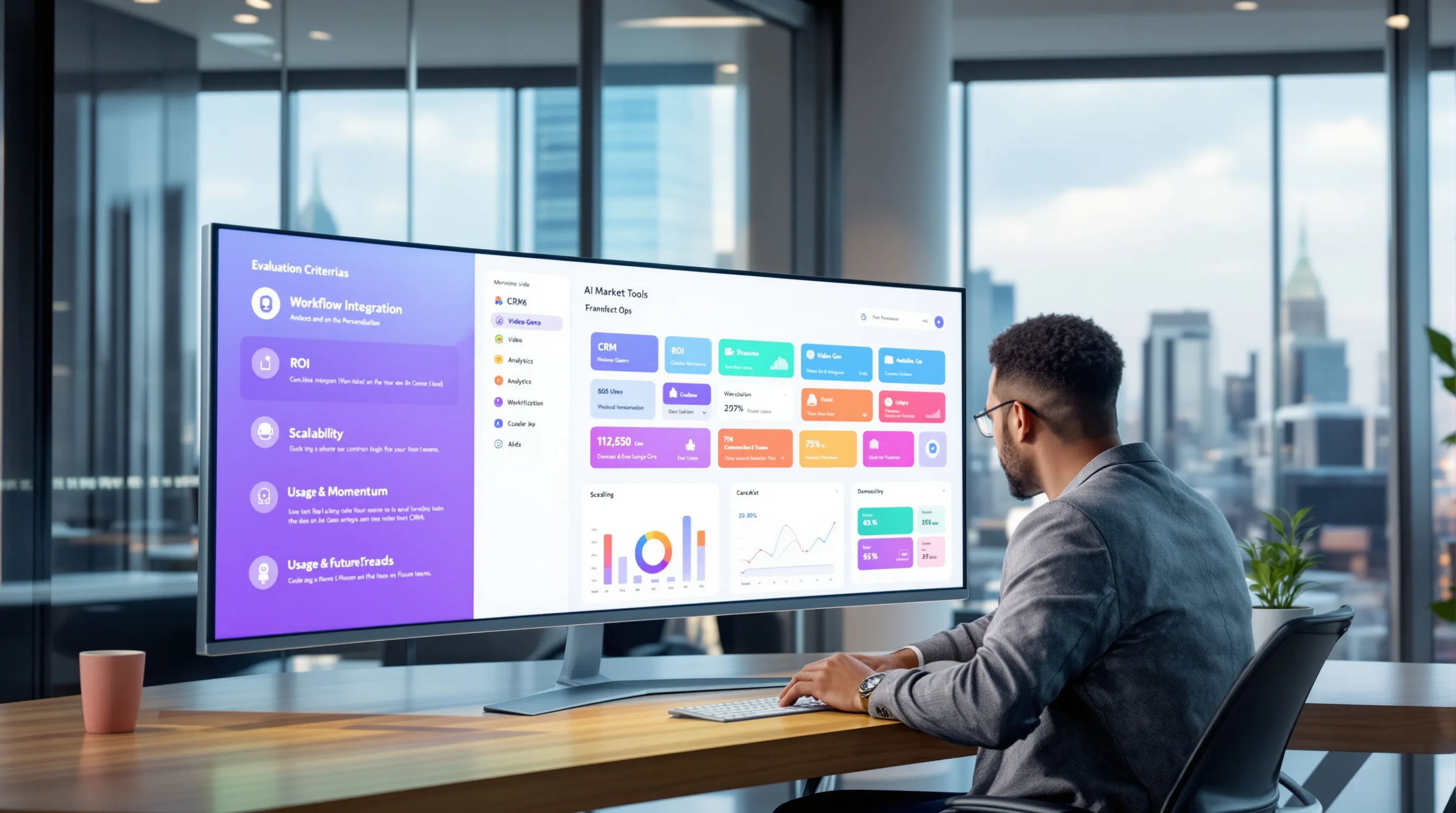
How We Evaluated These AI Marketing Tools
There are hundreds of AI products calling themselves “marketing tools.“ We focused on the ones that:
- Integrate into real workflows
Not just standalone toys. We prioritized tools that plug into CRM, analytics, ad platforms, CMS, or existing creative suites, and actually reduce manual steps.
- Show a path to ROI
Whether through predictive analytics, conversion uplift, lower CAC, or time saved. If we can’t see how it helps us hit pipeline or revenue, it didn’t make the list.
- Scale with growing teams
We looked for tools that support more complex use cases over time, more seats, enterprise security, multi‑brand or multi‑language, deeper personalization.
- Have real usage and momentum
A strong user base, active shipping velocity, and a clear roadmap for AI features in 2026.
- Align with where marketing is headed
We weighted tools that lean into 2026 trends: video generation, personalization, workflow orchestration, and agent‑like capabilities that can own a chunk of your funnel or ops.
These aren’t the only AI tools worth exploring in 2026, but they represent a practical cross‑section for content, personalization, CRM, video, and marketing ops that most modern teams can actually use.
10 AI Marketing Tools To Watch In 2026
1. Jasper: AI Content Co‑Pilot For Lean Marketing Teams
Jasper has evolved from a copy generator into more of an AI content co‑pilot for marketing teams.
Where it shines in 2026:
- Brand‑voice aware writing: You can train Jasper on your style guides, past content, and messaging, then generate net‑new assets that sound like your brand, not a generic AI.
- SEO and multi‑channel workflows: Outline a long‑form article, spin off social posts, email intros, and ad variations from the same core idea. It’s especially useful for lean teams that need volume without sacrificing consistency.
- Research acceleration: Jasper can help with first‑pass research, idea generation, and brief creation, so strategists can focus on angle and differentiation, not starting from a blank doc.
How we’d use it: As a content engine behind blogs, landing pages, and nurture campaigns, always with a human editor setting the brief, checking claims, and tightening copy.
2. Copy.ai: Fast Experimentation For Ads, Emails, And Funnels
Copy.ai is built for fast creative testing across paid and lifecycle channels.
What makes it interesting for 2026:
- Ad copy and headline testing at scale: Generate dozens of performance‑oriented variations for Google Ads, Meta, and LinkedIn in minutes.
- Email and funnel experimentation: Draft subject lines, body copy, and CTAs tailored to audience segments, then quickly test variations.
- Multi‑channel consistency: Keep offers and messaging aligned across ads, landing pages, and follow‑up sequences.
How we’d use it: Plug Copy.ai into our PPC and email testing cycles. Start with human‑written control copy, then let AI generate challenger variants. Use A/B tests to double down on what actually drives CTR and conversion.
3. HubSpot AI: Intelligence Layer On Top Of Your CRM
If your CRM is HubSpot, HubSpot AI becomes the intelligence layer on top of your customer data.
Key strengths:
- Lead scoring and prediction: AI‑powered lead scoring models help us focus sales and outbound efforts on accounts most likely to convert.
- Journey personalization: Recommend content, emails, and offers based on behavior and lifecycle stage.
- Forecasting and analytics: More accurate pipeline and revenue forecasting based on historical data and real‑time performance.
How we’d use it: As the brain behind lifecycle marketing, connecting website behavior, email engagement, and deal data so we can orchestrate more relevant journeys instead of blanket blasts.
4. Adobe Firefly: Visual Asset Generation For Brand‑Safe Creative
Adobe Firefly, powered by Adobe Sensei, is quickly becoming the creative backbone for teams already in the Adobe ecosystem.
Why it matters in 2026:
- Brand‑safe generation: Trained on licensed and Adobe‑stock imagery, Firefly is designed to reduce legal headaches and IP risks.
- Integrated into core tools: Firefly is embedded in Photoshop, Illustrator, and other Adobe apps, so designers can use AI for background replacement, image extension, and concepting without leaving their workflow.
- Faster asset production: Resize and adapt creative for different channels, localize imagery, and generate variants for testing.
How we’d use it: To support creative teams under heavy demand, turning one strong concept into a full slate of ad sets, landing page hero images, and social assets while preserving brand consistency.
5. Synthesia: Scalable AI Video For Training, Product, And Ads
Video demand keeps growing, but production budgets and timelines haven’t kept pace. Synthesia tackles that gap with AI‑generated, avatar‑based video.
Where it fits in 2026:
- Onboarding and training: Turn scripts or documentation into explainer videos without booking talent or studio time.
- Product tours and feature updates: Quickly create walkthroughs for launches, changelogs, or in‑app education.
- Localized campaigns: Generate videos in multiple languages using realistic AI voices and avatars.
How we’d use it: As a “good enough” video layer for education and lower‑funnel assets, reserving full production budgets for hero campaigns and high‑impact brand work.
6. Descript: AI‑Native Audio And Video Editing For Marketers
Descript is an AI‑native editing studio that lets us edit audio and video almost like a Google Doc.
What makes it valuable:
- Text‑based editing: Upload a recording and edit by changing the transcript, delete a sentence in text, it’s gone from the video.
- Filler word and silence removal: One‑click cleanup to remove “ums,“ “uhs,“ and long pauses.
- Repurposing content: Easily clip podcasts, webinars, and long recordings into short-form content for social and email.
How we’d use it: To scale a podcast, webinar, or video strategy without needing a full production team. Capture long‑form conversations, then use Descript to slice them into assets across channels.
7. Mutiny: AI‑Driven Website Personalization For Revenue Teams
Mutiny focuses on website personalization for B2B revenue teams, helping us turn generic pages into tailored experiences.
Why it’s one to watch:
- Segment‑based experiences: Show different headlines, social proof, and CTAs to visitors based on firmographic and behavioral data.
- AI‑suggested experiments: Mutiny suggests variants and tests optimized for conversion.
- Tight go‑to‑market alignment: Integrations with CRMs and ad platforms help tie web experiments back to pipeline and revenue.
How we’d use it: To transform our core pages (home, pricing, product) into dynamic surfaces that adapt to industries, company sizes, and funnel stages, especially for ABM and outbound‑driven teams.
8. Clearbit + AI: Smarter Targeting And Enrichment For B2B
Data quality and context fuel every AI‑driven campaign. Clearbit has long been a leader in firmographic and technographic enrichment, and its AI capabilities are making that data more actionable.
In 2026, Clearbit + AI can help us:
- Enrich inbound leads in real time: Auto‑populate company size, industry, and tools used, then route and score leads accordingly.
- Build stronger audiences: Feed high‑intent, high‑fit audiences into ad platforms instead of relying on broad interest targeting.
- Power personalization: Use enriched data to trigger relevant emails, chat playbooks, and website experiences.
How we’d use it: As the data backbone for B2B marketing, making our segmentation, scoring, and personalization actually work instead of relying on incomplete form fills.
9. Apollo AI Or Similar: Prospecting And Outreach Automation
Apollo, and similar platforms, combine prospect data with AI‑driven prospecting and outreach automation.
Why this category matters in 2026:
- Agent‑like outbound: AI can research companies and contacts, draft tailored outreach, and sequence follow‑ups with human approvals.
- Intent‑based prioritization: Combine firmographics, technographics, and engagement data to focus on the most promising accounts.
- Tighter sales–marketing orchestration: Marketing can help define the messaging, positioning, and triggers, while AI handles execution at scale.
How we’d use it: To power smart, targeted outbound as a complement to demand gen, not mass spam, but thoughtful, data‑driven outreach that mirrors how a good SDR would work.
10. Notion AI: Knowledge Management And Workflow For Marketing Ops
Notion AI isn’t a “marketing tool” in the narrow sense, but it’s becoming an important ops and knowledge layer for many teams.
What makes it useful:
- Centralized strategy and ops: Campaign briefs, playbooks, test logs, messaging frameworks, and creative reviews all live in one place.
- AI‑assisted documentation: Summarize meeting notes, extract action items, and keep project pages up to date.
- Workflow orchestration: Connect with tools and, paired with automation platforms, use Notion as the hub for approvals, status tracking, and learnings.
How we’d use it: As the single source of truth for marketing, where AI helps us keep documentation accurate, searchable, and actually used instead of forgotten in scattered docs and decks.
How To Pilot These AI Tools Without Burning Time Or Budget
The riskiest move in 2026 isn’t ignoring AI, it’s bolting on 10 tools at once with no plan.
A simple way to pilot AI marketing tools without chaos:
- Pick one workflow per team to improve
For example: blog production, paid ad testing, webinar repurposing, or lead scoring. Don’t try to “AI‑ify” everything at once.
- Limit yourself to 2–3 tools for a 90‑day test
Maybe Jasper for content, Mutiny for web personalization, and HubSpot AI for lead scoring. Or Descript + Synthesia for a new video strategy.
- Start with free tiers or trials
Most of these platforms offer trials or free plans. Use them to run a contained experiment instead of committing annual budget on day one.
- Define clear success metrics
- Content tools: time to publish, organic traffic, conversion rate
- Personalization: lift in demo requests or trial signups
- Outreach: reply rates, meetings booked, opportunity volume
- Run controlled A/B tests
Don’t compare AI output to nothing. Compare AI‑assisted vs. your current best process. Keep a simple experiment log in Notion to capture learnings.
- Invest in guardrails
- Human review for brand, accuracy, and compliance
- Clear data policies
- A shared “AI usage” guide so your team knows what’s okay and what’s not
The goal of a pilot isn’t to prove AI is magic. It’s to understand where AI genuinely gives your team leverage, and where the human touch is non‑negotiable.
Conclusion
AI won’t replace marketers in 2026, but it will absolutely reshape what high‑impact marketing work looks like.
Tools like Jasper, Copy.ai, HubSpot AI, Adobe Firefly, Synthesia, Descript, Mutiny, Clearbit, Apollo, and Notion AI are early signals of where things are headed: more automation, more personalization, and more pressure on us to bring the strategy, creativity, and judgment AI can’t.
If we treat these tools as co‑pilots, not crutches, we can spend less time wrestling with busywork and more time on the parts of marketing that actually move the needle: sharp positioning, thoughtful campaigns, and meaningful customer experiences.
The best time to start is with one well‑designed pilot. Choose a workflow, pick a couple of tools from this list, and give your team 90 days to learn. Our future selves will thank us for starting small, measuring rigorously, and building AI into our marketing in a way that’s sustainable, and unmistakably human.