
We talk a lot about strategy in digital marketing, but when we sit down to build one, things get messy fast.
Which channels should we bet on? How does AI fit in without turning everything into a Frankenstein tech stack? How do we keep our focus on revenue instead of drowning in dashboards?
In this text, we’ll walk through a concrete example of a digital marketing strategy from start to finish. We’ll use a realistic B2B SaaS scenario, show how we’d structure SEO, content, email, and PPC, and layer in AI and automation in a way that actually supports the strategy instead of distracting from it.
The goal: when you’re done reading, you’ll be able to adapt this framework directly to your own business, without getting lost in jargon or shiny tools.
Clarifying The Business Context And Goals
Before we touch channels or content calendars, we need to understand the business. A digital marketing strategy built in a vacuum is just a to‑do list.
Defining A Clear Growth Objective
We start with two questions:
- Where is the business today? (industry, position, pricing, sales motion, team capacity)
- What specific growth outcome are we driving in the next 6–12 months?
For a useful example of a digital marketing strategy, let’s define a concrete objective:
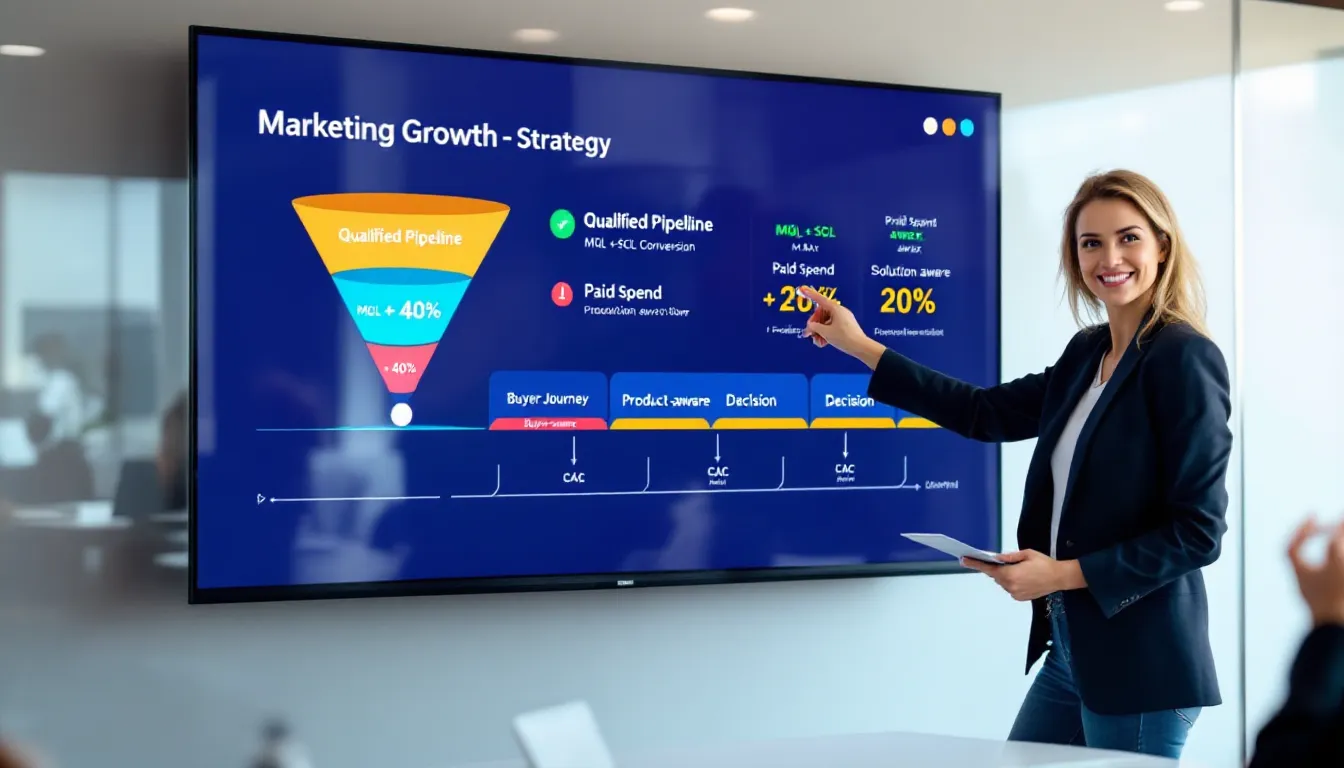
Objective: Increase qualified pipeline from inbound by 40% in 12 months while keeping customer acquisition cost flat.
That’s different from “get more traffic“ or “grow our email list.“ It’s tied to revenue and efficiency:
- Primary metric: Sales-qualified opportunities (SQOs) from inbound
- Supporting metrics: MQL → SQL conversion rate, demo requests, CAC
- Guardrails: Don’t increase paid spend by more than 20% without improving conversion rates
This level of clarity protects us from chasing vanity metrics (impressions, likes, low-intent leads) and helps us make tradeoffs once we start designing campaigns.
Understanding The Target Audience And Buyer Journey
Next, we map who we’re talking to and how they actually buy.
In 2026, the buyer journey isn’t linear. Our prospects bounce between:
- Google (including AI-generated answers)
- LinkedIn, YouTube, TikTok
- Email, Slack communities, events
- Review sites, peer recommendations
We want a simplified but realistic map:
- Who: Senior marketing leaders (e.g., Heads of Demand Gen, CMOs, Growth Leads) at mid-market B2B companies in the U.S.
- Pain points: Rising CAC, fragmented data, pressure to show ROI, limited team bandwidth
- Buying dynamics: Multi-stakeholder (marketing + RevOps + finance), 3–6 month cycle, heavy on proof and social proof
Then we outline key stages:
- Problem-aware: “Our CAC is climbing. Our channels feel scattered.”
- Solution-aware: “We might need better segmentation, attribution, or automation.”
- Product-aware: “We’re comparing platforms that help reduce CAC with smarter targeting.”
- Decision: “We need internal alignment and proof that this will pay off quickly.”
This buyer-journey view lets us align SEO, content, email, PPC, and sales enablement so they’re all pulling in the same direction, and it informs where AI-driven personalization can actually help, instead of just sounding clever.
Selecting The Right Digital Channels

Once we know who we’re trying to reach and what outcome we want, we can pick channels with intention instead of defaulting to “be everywhere.“
Evaluating Channel Fit: Search, Social, Email, And Paid
We look at four core channels first, then decide where AI can expand our reach or efficiency.
- Search (SEO + AEO/GEO)
- Buyers are actively looking for solutions and frameworks.
- AI-generated search results (AEO/GEO) favor strong topical authority and clear answers.
- Great for demand capture and evergreen thought leadership.
- Social (especially LinkedIn + short video)
- Our audience lives on LinkedIn and increasingly consumes short-form video.
- Social is no longer just top-of-funnel: it’s a storefront with in-feed product demos, case studies, and even native conversion points.
- Still the backbone for nurturing, education, and sales alignment.
- Works best when powered by behavioral data and segmented journeys, not generic blasts.
- Paid (search + paid social)
- AI-driven bidding and targeting can surface us to the right people fast.
- Video and high-signal offers (e.g., “ROI calculator,“ “cost-reduction playbook”) outperform generic “Book a demo.”
Prioritizing Channels Based On Intent And Resources
We don’t need to dominate every channel. We prioritize based on intent, cost, and internal capacity:
- Primary channels: SEO/content, LinkedIn (organic + paid), paid search
→ High intent, can scale with AI-assisted research and creative.
- Secondary channels: Email nurture, YouTube, retargeting
→ Strengthen conversion and trust.
- Experimental: AR/VR experiences, TikTok for specific verticals, interactive tools
→ Small, structured bets with clear hypotheses.
For our example strategy, we might allocate:
- 40% effort → SEO + thought leadership content
- 30% → LinkedIn (founder-led + brand + paid)
- 20% → Paid search + retargeting
- 10% → Experiments (interactive calculators, AR demos, etc.)
AI and automation support all of this (keyword clustering, creative testing, segmentation), but they don’t decide the mix. Our business goals and audience do.
Designing The Core Digital Marketing Strategy (With Example Scenario)
Now let’s turn this into a concrete example of a digital marketing strategy you can adapt.
Example Scenario: B2B SaaS Company Targeting Marketing Leaders
Company: B2B SaaS platform that uses AI to help marketing teams improve segmentation and reduce CAC.
ACV: $30K–$80K
Sales motion: Sales-assisted, 60–120 day cycles
Goal: 40% increase in qualified pipeline from inbound in 12 months.
Constraints:
- Lean team (1 demand gen lead, 1 content marketer, shared designer)
- Modest ad budget but strong executive support
- Early but growing customer proof (5–10 solid case studies)
Positioning, Messaging, And Content Pillars
We anchor strategy on a simple positioning statement:
For growth-focused marketing leaders, our platform reduces customer acquisition cost by up to 30% through AI-powered segmentation and cross-channel optimization, without adding headcount or ripping out your current stack.
From there, we define 3–4 content pillars:
- AI in Modern Marketing
- How AI reshapes segmentation, attribution, and campaign optimization.
- Guides: “New Rules of AI-Driven Demand Gen,“ “How AI Can Cut CAC Without More Budget.”
- Performance & CAC Reduction
- Playbooks for reducing CAC, improving ROAS, and scaling efficiently.
- Case studies: “How X Cut CPL by 30% in 90 Days.”
- Data & Measurement
- Practical analytics, dashboards, and revenue reporting frameworks.
- Content: “The CMO’s Revenue Dashboard,“ “Attribution That Doesn’t Break Your Team.”
- Change Management & Team Enablement
- How to roll out AI-driven tools without burning out the team.
- Webinars, roundtables, leadership content.
Each pillar supports both the buyer’s problems and our product narrative, which means every asset does double duty, educating the market and reinforcing our solution.
Mapping Tactics Across The Funnel
We then map tactics across TOFU, MOFU, and BOFU with clear offers.
Top-of-funnel (TOFU) – Problem & solution awareness
- Long-form SEO articles targeting queries like:
- “AI marketing trends 2026″
- “how to reduce CAC in B2B SaaS”
- “example of digital marketing strategy for B2B”
- LinkedIn thought leadership: POV posts from the CMO/Founder, carousels breaking down experiments, short video clips.
- Short videos on LinkedIn & YouTube Shorts: “60-second teardown” of ad accounts, CAC breakdowns.
Mid-funnel (MOFU) – Evaluation & education
- Webinars on topics like “How We Cut CAC by 30% Using AI Segmentation.”
- Interactive tools (e.g., CAC calculator, “Channel Mix Simulator“).
- Case studies with concrete numbers (30% CPL reduction, 20% uplift in pipeline velocity).
- Email nurture sequences triggered by content downloads and intent signals.
Bottom-of-funnel (BOFU) – Decision & validation
- Personalized product demos tailored to their current stack and KPIs.
- ROI one-pager auto-generated with their inputs from the calculator.
- Live Q&A sessions or office hours for high-intent accounts.
- Sales enablement content: competitive one-pagers, proof packs, and objection-handling decks.
The strategy isn’t “run SEO and ads.“ It’s own specific conversations at each stage and connect them with clear next steps.
Building The Content And Campaign Plan
With the strategic spine in place, we translate it into an executable plan: what we publish, where, and in what sequence.
Top-Of-Funnel: Attracting The Right Traffic
Our TOFU goal isn’t “more eyeballs”: it’s more right-fit attention.
Key plays:
- SEO content hub:
- One pillar page: “AI-Powered Digital Marketing Strategy: The 2026 Playbook.”
- Cluster articles answering specific questions (e.g., “example of digital marketing strategy for B2B SaaS,“ “AI vs manual segmentation: when to switch“).
- Use AI tools for topic clustering, SERP analysis, and draft outlines, then refine with human judgment and original insights.
- Thought leadership series on LinkedIn:
- 3–4 posts per week from the founder/CMO.
- Mix hot takes (“Stop Blaming CAC on ‘Bad Leads’“) with concrete breakdowns (“How We Audited a $300K Ad Account in 3 Days“).
- Paid search for high-intent terms:
- Target “AI marketing platform,“ “reduce customer acquisition cost,“ “B2B AI segmentation tool.”
- Drive to targeted landing pages, not the homepage.
Mid-Funnel: Nurturing And Educating Prospects
At MOFU, we’re turning curiosity into confidence.
- Lead magnets tied to real outcomes:
- “CAC Reduction Playbook“ (with templates and benchmarks).
- “AI Segmentation Test Plan“ that a demand gen manager can run in 30 days.
- Email nurture tracks:
- Segment by role, company size, and primary pain (e.g., “CAC too high,“ “data too fragmented“).
- Use AI to generate initial variations of subject lines and snippets, then A/B test and refine.
- Include short videos, quick wins, and customer proof, not just long essays.
- Webinars and live sessions:
- Monthly “campaign teardown” or “office hours” using anonymized data.
- Follow up with tailored content and a soft CTA to see a customized demo.
Bottom-Of-Funnel: Converting High-Intent Leads
Here, precision matters more than volume.
- Dynamic product demo flows:
- On the “Book a demo“ page, ask 2–3 smart questions (primary channel mix, main KPI, current CAC).
- Use automation to route leads to the right AE and pre-load context in the calendar invite.
- Personalized assets:
- Sales sends a short Loom or video walkthrough highlighting how the platform would reduce CAC for that specific prospect.
- AI can help generate a first-draft ROI model based on benchmark data: humans validate and present it.
- Retargeting with high-intent offers:
- Ads promoting case studies, ROI calculators, or limited-time onboarding packages.
- Suppress existing customers and low-fit personas to keep spend efficient.
The result is a coherent content and campaign ecosystem: every asset has a job, every campaign points to a next step, and AI is used to increase our speed and relevance, not to replace our strategy.
Measurement, Experimentation, And Optimization
Even the best strategy is a draft until we see how the market responds. Measurement is where we separate opinions from reality.
Defining KPIs And Setting Benchmarks
We align metrics to our original objective:
- North star: SQOs from inbound + pipeline value
- Leading indicators:
- TOFU: organic traffic to key pages, high-intent keyword rankings, qualified demo requests
- MOFU: content-to-lead conversion rate, webinar attendance, email engagement by segment
- BOFU: demo-to-opportunity rate, sales cycle length, win rate, CAC
We set initial benchmarks from historical data or industry ranges, then define what “good” looks like in 90 days vs. 12 months.
Running Experiments And Iterating The Strategy
We treat each channel as a series of experiments, not a fixed playbook.
- In SEO: Test content depth, angles, and internal-link structures. Use AI to identify emerging topics and questions from SERPs and forums.
- In paid: Test offers (demo vs. calculator vs. playbook), creative formats (static vs. video), and audience segments. Let AI bidding optimize within clear guardrails.
- In email: Test cadence, personalization depth, and multi-channel sequences (email + LinkedIn touch + retargeting).
We run experiments in time-boxed sprints (e.g., 4–6 weeks), review results, and either scale, tweak, or kill. The strategy evolves based on evidence, not on the loudest opinion in the room.
Integrating AI And Automation Into The Strategy
AI is most powerful when it’s boring, when it quietly makes our existing strategy faster, smarter, and more scalable.
Where AI Adds Leverage (Without Replacing Strategy)
We slot AI into specific leverage points:
- Segmentation and scoring:
- Use predictive models to score leads based on behavior, firmographics, and past conversion data.
- Improve routing and prioritization, especially for sales.
- Content ecosystem building:
- Cluster keywords, map topical authority gaps, and generate outline options for pillar pages and supporting articles.
- Analyze SERP intent and competitors at scale, then we decide where to differentiate.
- Personalization and messaging:
- Dynamic email copy variants by segment.
- Personalized website sections for key accounts or industries.
- Analytics and insights:
- Automatic anomaly detection (e.g., “CPL spiked 25% in this campaign last week“).
- AI-generated summaries of performance for weekly standups.
What AI doesn’t do: set strategy, understand your category nuances, or build trust with your audience. That still comes from us.
Practical Automation Ideas Across The Funnel
We can embed automation throughout the funnel without turning everything into a black box.
Top-of-funnel
- Auto-publish content variations to different channels and collect performance data.
- Use AI tools to repurpose one webinar into a blog post, LinkedIn thread, and short video clips.
Mid-funnel
- Trigger nurture sequences based on behavior (e.g., multiple visits to pricing, repeat visits from the same account).
- Automatically enroll webinar attendees into follow-up journeys tailored to their questions or poll responses.
Bottom-of-funnel
- Auto-generate pre-call briefs for sales from CRM, website behavior, and email engagement.
- Trigger personalized case-study bundles based on industry and use case when a deal enters a late stage.
The point isn’t to automate for automation’s sake. It’s to free our team to focus on positioning, creative angles, and relationship-building, the things AI can’t do well.